Wednesday, 17 December 2014

Tuesday, 16 December 2014
Friday, 21 November 2014
Monday, 3 November 2014
Preliminary Task Evaluation
Question 1
Initially, our group decided to start by mind-mapping some ideas of the storyline/conversation topic and coming to a conclusion. The group decided that the conversation should start off in a dream state, and then fade into reality. We decided this as it meant we could use more effects during the editing and provided us with enough depth to make the finished product of the highest quality. After this, we started to decide on who would be assigned which role. Additionally we planned on the location of all the shots and where we would hold the conversation and what types of camera shots we would use in these locations. For example, we decided to use the corridors outside the media room, as they were long and almost had a vanishing point on them, allowing us to film low angle shots that gave the appearance of a never ending corridor, adding to our dream like world we was aiming for. Once we had all come to a decision, each individual produced their own storyboard to help the group understand how and where we would shoot the task.
After we had done this, we was asked to research different camera angles and shots. I feel this helped us during the production as it helped add a more professional look to it. It also kept the task from being repetitive and boring in it's aesthetics. It also helped the group decide on which camera shots would fit each part of the plot.
Once we had researched and planned the task, we shot a rough draft of the film. We used this to help us decide which parts fit and which didn't. It also allowed the group to experiment with the dynamics of the camera shots/angles. The topic of the conversation was also developed during this stage. The group decided that the first character had been dreaming and was being woken up as they were late for class. The draft shot helped us in the production as it allowed the group to see what would produce a better quality of film.
Question 2
Previous to this preliminary task, I already had more advanced experience with cameras, as I have produced short films and videos for YouTube. This allowed me to share those experiences in this task. I feel this helped the group as it allowed us to produce a more high quality film. However, despite previous experience, I still experimented with different camera shots that I had not used before. This helped broaden my knowledge for further projects for school and for personal use. I feel that I have learnt a few skills that can be applied to our thriller task.
Question 3
Before the production of our preliminary task, I had edited countless videos for my own short films and videos for YouTube. This gave me an advantage when editing together our final cut. However, the editing software we used for this (Adobe Premiere) was different to the one I had previously used (Sony Vegas Pro). This meant that I learnt a bit more about new software which I feel helps me for further projects when access to Sony Vegas may not be available. I felt very confident when editing and managed to get the clips together with no trouble. The only trouble I had was editing the audio, however I later managed to solve this with some troubleshooting. I did learn a new technique when editing, which was being able to use keyboard shortcuts to help make the process easier for me. This will help me in further projects and will carry over into personal products. The editing was also done on a Windows PC, which is similar to what I used so I didn't struggle navigating the software, as opposed to Apple Mac.
Question 4
I feel that the group worked well together and we all were able to share ideas. Although previously not knowing everyone, the task has helped us form a friendship and will help us when we come to producing a thriller. We were also very organised which helped the whole process immensely.
Preliminary Task Planning
Group 4:
Reece, Tom, Emily and Olivia
Roles:
Tom - Actor 1
Olivia - Actress 1
Reece - Camera
Emily - Camera
Locations:
CNS Gate
CNS Sixth Form Common Room
CNS Corridors
CNS Media Studies Room
Props:
None used
List of Shots:
Low Angle, Close - Actor running past camera
High Angle, Medium - Actor running into school
Pan Shot, Medium - Actor entering through doors
Low Angle, Medium - Actor running down corridor
Birds-eye - Actor running down corridor
Close up - Actor opening door
Over The Shoulder - Actor and Actress having conversation
POV - Actor waking up
High Angle - Actor and Actress conversation
Tracking - Actress walking out
Over the Shoulder - Actress walking out
Close up - Actress slamming door shut
Storyboard
(Needs to be scanned)
Reece, Tom, Emily and Olivia
Roles:
Tom - Actor 1
Olivia - Actress 1
Reece - Camera
Emily - Camera
Locations:
CNS Gate
CNS Sixth Form Common Room
CNS Corridors
CNS Media Studies Room
Props:
None used
List of Shots:
Low Angle, Close - Actor running past camera
High Angle, Medium - Actor running into school
Pan Shot, Medium - Actor entering through doors
Low Angle, Medium - Actor running down corridor
Birds-eye - Actor running down corridor
Close up - Actor opening door
Over The Shoulder - Actor and Actress having conversation
POV - Actor waking up
High Angle - Actor and Actress conversation
Tracking - Actress walking out
Over the Shoulder - Actress walking out
Close up - Actress slamming door shut
Storyboard
(Needs to be scanned)
Working Title Fact File

Founders: Tim Bevan & Sarah Radclyffe (Eric Fellner is now co-owner)
Owners: Comcast Corporation
Headquarters: London, United Kingdom
Working Title are a UK based film company producing many British films such as Notting Hill, Johnny English and Anna Karenina. Although when started producing films for PolyGram, PolyGram soon folded into American company Universal Studios. Since then, Working Title films has built up it's reputation with blockbusters such as Rush, Senna and Les Miserables.
In 2010, Working Title launched it's own TV division, known as Working Title TV (WTTV), as a joint venture with parent company NBC Universal.
In 1999, WT2 was launched a subsidiary company to Working Title Pictures. The company is run by Natasha Wharton, and has helped produce films such as Billy Elliot and Shaun of The Dead.
Working Title are contractually entitled to produce any film with a budget up to £35 million.
Working Title have made a formula for their films which interests a broader audience. They use British ideas with American stars, drawing in an international audience and enhancing the reputation of British film.

Tuesday, 7 October 2014
AS Media Questionnaire
Questionnaire
About Me
In my spare time, I like to do a variety of things ranging from sports to the more relaxed video games. I would say that I take a relaxed approach to life and try to enjoy it. Some of my favourite sports are Football and Basketball. The two teams I follow in Football are Arsenal and Charlton. In Basketball I also follow two teams; Oklahoma City Thunder and Indiana Pacers. I also enjoy listening to music in my spare time as it helps me relax.

1) The majority of Print Media I get is from social networking or online in general. Most news I see comes through my Twitter feed. In terms of types of print media, I generally stick to things that interest me (such as my hobbies) or current world news. I think it is interesting to see the views of different situations in life. From time to time I also read fun articles such as the one below:
I don't often read magazines as I find they are too expensive when you can get most the content in them online.
2) I don't often listen to the radio as I don't like Ads, but when I do I listen to any radio station that isn't Classic FM. I only listen to radio when access to music is limited. In the car I will listen to the radio that my mum listens to.
3) My favourite genres of music are Blues and Rock. I do also enjoy some modern soul and rap. One of my favourite artists at the moment is Kwabs:

I think that the current music industry is at a bit of a fall due to the high amounts of illegally downloaded music. I also feel however, we can not blame the people doing this as songs are very overpriced and can only be obtained through i-Tunes or albums in-store, both of which are highly overpriced.
4) In terms of video games, I have always been a huge consumer of them. These days I tend to play games that are more strategy based or sporty. My favourite games at the moment are games such as Hearthstone (Strategy) , FIFA (Sport) and NBA (Sport). I think that overtime my taste in games has changed. When I was younger I enjoyed more fantasy and adventure games but these days I tend to stick to more realistic games.

My first experience of games was when I was 4 and I got a PS1 for Christmas. Ever since, my passion for gaming has not stopped and shaped most of my childhood. Video games were my way of escaping the real world and relaxing.
My favourite games of all time include: Crash Bandicoot, Spyro and all FIFA titles.
5) Social media has changed the way we interact and socialise with others. My general opinion of social media is positive; however there are some aspects that affect us negatively. My positive views of them include the fact that it can keep people up to date with current news and also allows people to communicate freely. Negative issues stem from online bullying and harassment. Information is also easily obtained through hacking and has caused issues globally.
6) In terms of TV, I rarely watch it. I find that most things I watch are online so therefore see no point in watching TV. The only channels I watch on TV are Comedy Central, Sky1 and ITV (when the Football is on).
I watch Comedy Central as the programs aired on it are ones that I find interesting and entertaining. This is mainly due to the comedic value of the programs ; South Park, Friends, How I Met Your Mother.
Sky1 is the source of programs such as Futurama and The Simpsons; both of which are two of my favourite programs. I like these programs as they are funny and I have always liked cartoons. One of my favourite programs of all time is a cartoon; Tom and Jerry.
Another one of my favourite TV shows is Breaking Bad. The program is unique and is gripping. As I'm getting older, I'm finding that US shows interest me more.

7) Film has played a big part in my life as I enjoy watching them and watch them regularly. My favourite genre of films is Comedy, Action and Animation. Some of the best films in my opinion are anything Disney or Tarantino.
My favourite actor is Tom Hanks as many of the films he has starred in rank high up on my list. One of his performances comes in Forrest Gump. I like his style of acting and think that he always adds a light hearted twist on characters.
Other films that I enjoy include Pulp Fiction, Hot Fuzz and Toy Story as it reminds me of my childhood.
8) In terms of media, I have produced a short comedy sketch, parodying iconic films, with a few of my friends during a Video Production week. The project taught me a few things about media production and also broadened my view of it. It is one of the reasons I chose media.
I also have produced YouTube videos in the past, to a point where I started making a small earning out of it through the YouTube Partner program. I have considered restarting it but have not had the time or funds to invest in it. However, it still influences my type of media production now.
9) I chose Media Studies because of the before mentioned project and my love for producing YouTube videos. I am also a frequent media user and see it as a way of broadening my skills in media analysis.
GCSE grades
English - B
Maths - B
Science - C
Philosophy and Ethics - B
Food Technology - B
History - A
German - C
IT - Pass
Further ICT - Yet To Recieve
Monday, 22 September 2014
Rush (2013) | Working Title Films
Rush (2013) Trailer
Review

Rotten Tomatoes Review of Rush
How is Rush packaged?
Rush is packaged in a number of different ways:
Established audience | The film already has an established audience of Formula One fans. This brings these type of people to the cinema to watch the film
Love story | The film uses a love story as an underlying theme attracting American viewers.
Aristocracy Character | The portrayal of James Hunt (an English aristocrat) also draws in the American viewers who see characters like this as stereo-typically English. Other examples of this is their view of Hugh Grant.
Special Effects | The film uses a wide variety of special effects that even Michael Bay would be impressed with. The film uses these effects in scenes like the crash to attract the fans of Formula One as well.
Secret Cinema Research

"Secret cinema is a growing community of all that love cinema, and experiencing the unknown. Secret audience. Secret film. Secret locations. Secret worlds. The time is now to change how we watch films.
Tell No One."
The Secret Cinema is an immersive cinema experience company founded by Fabien Riggall. The company largely focus on making experiences of popular films such as:
-Back To The Future
-Ghostbusters
-Alien
-Bladerunner
-Prometheus
-The Shawshank Redemption
The company create immersive experiences by making the films interactive. They do this by re-making sets and getting the audience involved in the action. The Back To The Future event allowed attendees to dress up in the style of 2015 Hill Valley (Back To The Future II) ushering in fans from all around the globe.
Despite this, the Secret Cinema has had many criticisms over it's poor organisational skills, often having shows cancelled an hour before the screening. This has in the past lead to national news headlines; most notably the Brazil screening where many people had flew in from other countries and where stuck with no accommodation after the cancellation.
The company aims at adding a mysterious twist to cinema and looks to innovate the way we watch films.
Saturday, 20 September 2014
Wednesday, 17 September 2014
The Seventh Seal | Camera Shots | Skills-O-Rama
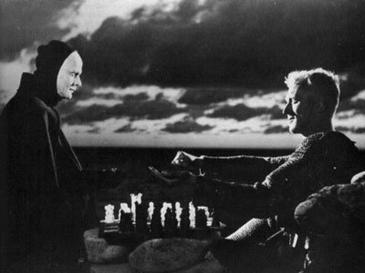
The Seventh Seal, directed by Ingmar Bergman, demonstrates a wide variety of shot types in the scene where the Knight first meets Death.
In class, we discussed the above clip and how the director uses different shots for different effects.
Below is a short Prezi which shows some brief information about the film:
Some of the shots used within the short clip show different things. For example, this still below shows a great use of the over the shoulder camera shot. This shot is generally used when two characters are in dialogue, in this case the Knight and Death.


In class, we discussed the above clip and how the director uses different shots for different effects.
Below is a short Prezi which shows some brief information about the film:
Some of the shots used within the short clip show different things. For example, this still below shows a great use of the over the shoulder camera shot. This shot is generally used when two characters are in dialogue, in this case the Knight and Death.
Below; an iconic still from the film
Subscribe to:
Comments (Atom)